Friday, February 11, 2011

05-09.02.11 San Pedro De Atacama


San Pedro De Atacama is a small unpaved oasis town of single storey mud and clay 'adobe' houses in the middle of the Atacama Desert at 2,436 mtrs above sea level. Needless to say, it’s hideously hot during the day whilst temperatures plummet at night. The town draws travellers from all over the world who come to see the volcanoes, geysers, sand dunes, lagoons and salt flats.  The bus ride here was unique. Vast planes of nothingness interspersed with ear popping changes in altitude. 

It hadn't rained here for 3 years but it rained heavily a couple hours after we arrived and were told it was the 3rd day of rain. The rain comes between 6 and 7pm but heavy down pours here have catastrophic effects on unpaved access roads meaning the El Tatio Geysers and the Ojos De Salar were not immediately accessible.

For our first day we booked a guide to see the antiplano salt lagoons. Rach was suffering from a stomach bug so we very nearly postponed the trip. Forever the brave, Rach decided to go ahead with the tour. Our man Pedro picked us up from our hostel at 6am in his 4x4 and drove for 2 hours on unpaved roads to Lagunas Miscanti and Miniques at 4,200 metres above sea level. We were quite literally left breathless both by the stunning scenery and the altitude. Unfortunately Rach wasn’t feeling too well and decided to chew on some coca leaves, a well known, and legal, local remedy for altitude sickness. No joy, it just made her feel more sick. We are not sure of it was the bug or the height but it was a stark reminder that altitude needs to be respected and proper acclimatization is vital. 

Early moring at Laguna Miscanti where we had breakfast


Rach with our guide Pedro


The huge pools of azure blue were ringed by white ribbons of salt with herds of wild llamas, known as vicunas, grazing along the shore. After visting a couple of other high altitude lagoons we arrived at the salt lake Lago Tuyajto. The salt formations were staggering an unlike anything I have ever seen. Later in the afternoon our mate Pedro drove us to the Salar De Atacama’s Laguna Chaxa, a weird lake of bizarre salt formations doubling up as a national reserve for numerous types of flamingos.

Rach and I at Salt Lake Tuyajto at 4,000 mtrs


Agua Calientes salt lake with volcanoes in the distance


Incredible array of colours. Hot to cold


Flamingos in the desert


Lake Chaxa, Salar De Atacama


Upon our return Pedro stopped on the ancient Inca route to Lima where rocks are formed into cairns to make a wish. Oh, not touristy at all, not one bit. Yes, of course we did!  See below...


We had originally planned just 3 days here but a lack of buses meant we had 5 days. In reality this was a bonus allowing the quagmire on the El Tatio access road chance to dry up. With time on our side we decided to hire some bikes and cycle through open desert to the Valle De La Luna, Chile's Moon Valley.  Luckily the 20km ride to the valley was beneith a blanket of cloud away of the sun's brutal rays. The valley itself was stunning and more like mars we thought. We took occasional stops through the valley visiting strange otherworldy geographical formations. Our favourite being the Star Wars-esque canyon with pitch black caves where head torches were necessary to complete the loop. An experience made even better given the fact we were completely alone.

Enroute to the Valle De La Luna, the Moon Valley


The start of the canyon loop


 The cave. It was actually pitch black in here without the flash, and 'no' there was no booze involved!


The formation on the right is known as the ampitheatre for obvious reasons


With luck on our side we were able to get to the famous El Tatio Geysers on our last day in San Pedro. We were picked up at 4am to get to the worlds highest geothermal field (4,320 mtrs asl) where the geysers are most active from 6 to 8am. The 2 hour journey took 3 hours as our driver worked his magic through landslides and rivers to arrive around 7am. The geyser were sporadically spewing steam and jets of boiling water. They seem to be alive 'erupting' every 3 to 5 minutes. An incredible sight but to be honest I was expecting them to be a little higher and a bit more dramatic. Not that I am asking for much of course...

 The geothermal field from a distance


Up close and personal. Well over boiling point


I took this without even knowing the bird was there. Lucky eh?


San Pedro is amazing. A true oasis in the middle of the desert and an absolute must if visiting Chile. Just watch out for the dogs. Like any other town in Chile, they roam the streets in gangs and chase anything with wheels, they even sandboard.

Gang of 5 dogs on their way sandboarding, the 6th wasn't invited...


Sorry, it must be the altitude!

02-04.02.11 La Serena & Elqui Valley

We had banked on a bit of walking to find a hostel for our stay but we turned up at our hostel of choice without a booking to find they had two beds left in a private room – result. 

The following day we jumped on a bus to the Elqui Valley with Sam and Julie, a really nice couple from our hostel.  We bought a ticket which allowed us to hop on and off the local bus at any of the towns and villages on route so we headed to the last stop on the line Pisco Elqui.

The Elqui Valley - a lush green oasis


The main attraction of this sleepy village was the Mistral Distillery, where the Chilean national drink ‘pisco’ is made.  Luckily, we had missed the 11am tour (a bit early to get on the alcohol) so we wandered around the village until the next tour commenced. 

Pisco Elqui main square

The tour was only in Spanish but we managed to get the gist that the Pisco making process was the same as making wine and then distilled to make the liquor.  We finished off the tour with some tasting – one a bit like brandy and the other a bit like tequila.  I expect both of them taste better when mixed with coke or made into a pisco sour!  After a relaxing half an hour sat in the pretty gardens sampling the pisco sour with our friends, we hopped back onto the bus to the nearest town Vicuna.

Giant cactai in Pisco Elqui


Mistral Distillery terrace


We split with Sam and Julie on arrival to explore at our own pace and quickly realised that apart from the main square and a couple of churches, there wasn’t much for us to see. 

An artist at work in the main square in Vicuna


We walked down a couple of streets and found a cheap bar to contemplate our next move.  We picked a cracker of a bar that basically had 2 drunks, a bar man and a duke box playing awful Chilean country and western style music.  We are certainly not saying that all Chilean music is awful just the music the drunks were selecting!!!  We somehow got chatting to the resident drunk.  Well, perhaps chatting is a bad description.  He kept mumbling a load of drunken Spanish to us, the bar man then translated into normal Spanish and we got the gist of it.  Mostly it was having a go at the Argentineans saying that Chile was a better country serving better wine and pisco and has better men (indicating himself we could only assume!)

Somehow I was persuaded to start dancing with the crazy fella, something I instantly regretted as the man got far too close for comfort.  It gave Ryan and the bar man something to be chirpy about though!!  Safe to say, we left shortly after in a cloud of embarrassment…

Rach and some strange man dancing to Chilean country and western


We headed back to our hostel to be picked up at 830pm for a night of star gazing at the Observatorio Cerro Mamalluca, located 9km from Vicuna.  We arrived for the English speaking tour at 11pm to be wowed from the instant we arrived.  The Elqui Valley has between 345 and 360 cloudless night skies per year making it one of the best places in the world to star gaze.  The night we arrived was no exception, and without telescopes we could clearly see the Milky Way, Orion, the Seven Sisters, Taurus, Gemini, Scorpio, Cancer, the Southern Cross and Beatlejuice amongst others (with the help of our guide and laser beams of course).  We also used several of the public telescopes to view clusters of stars - 3 or more stars are called a cluster.  One of the clusters we viewed had 250+ stars within the cluster, of which our naked eye could only see one.  It was amazing and to top it all off, we saw several shooting stars as clear as day (or night!).  The guide was brilliant, really enthusiastic and engaging and made quite a complex subject really fun.

Telescope at Observatorio Cerro Mamalluca - one of the only photos the camera could manage to take! [James Bond I thought...Ry]


The following day we spent some time walking along the beach front at La Serena before jumping on the night bus to San Pedro de Atacama, our last stop in Chile.

Sun setting behind a church, La Serena


Monday, February 7, 2011

30.01.11 - 01.02.11 Valparaiso & Vina Del Mar

‘Valparaiso is Chile’s principle port and naval base. It is also said to be perhaps the country’s most vibrant and liveliest city’ at least so it says in the guidebook. Imagine our surprise when we got off the bus into what felt like downtown Beirut. Our first impressions were of a run down city in dyer need of redevelopment. It had a spookiness I just couldn’t place. We checked into what felt like a very weird hostel. Our macabre host showed us to our room in the huge yet deserted building next door. Picture Norman Bates in Psycho showing a couple of freshers around a student house…. Somewhat confused and under whelmed we ventured out to explore this apparently dead city.

Streets of Valparaiso. Check out the telephone cables. Mayhem!


Of course, it hit us. Not only was it Sunday it was siesta time, everything was shut and people were indoors – this has happened to us before. Note to self - avoid arriving in a city on a Sunday. It’s bleak.

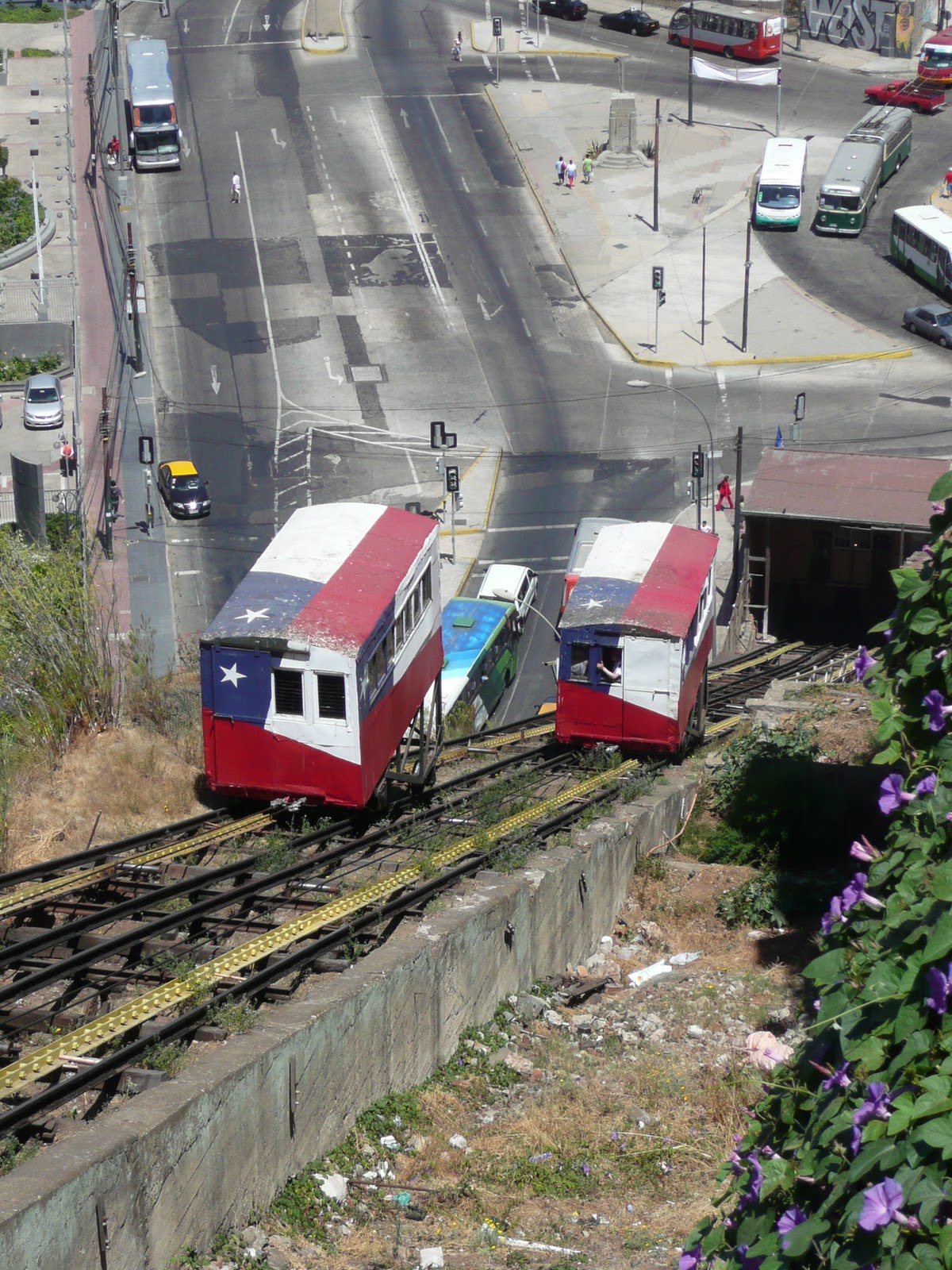
Valparaiso’s biggest attraction is without doubt it’s hills accommodating different neighbourhoods each overlooking the city. The hills are all served by funiculars, extremely cheap antique trains transporting the lazy, and us, up and down.  We stumbled across the Ascensor Concepcion, the oldest antique funicular in the city. Once numbering 33 but now down to 12, Valparaiso’s ‘ascensors’ were built between 1883 and 1916. We spent a couple of hours just meandering up and down the area’s winding narrow streets linking Cerro Concepcion and Cerro Alegre for panoramic views of the city and the port. After a quick beer in a sailors bar we headed back to our hostel, to our delight the streets were busier and our host had very quickly developed a personality, he was even rather chirpy.  Better still there was life in the hostel helping to dispel the Hitchcock like ambiance.

Ascensor Artilleria, One of the cities antique funiculars painted with the Chilean flag. Chileans are extremely patriotic


The hills are popuilated with the residential neighbourhoods whilst the valley bottom accommodates offices, shops, the port and the nightlife


The narrow streets are lined with bright colourful houses giving the town a unique character


The following day we caught a bus to Vina Del Mar 15 minutes up the coast having been told it was one of Chile’s most popular beach resorts. In short, it was poor and not worthy of many words. The beach was dirty and full of dogs, real dogs. We spent a couple of hours chilling on the grass adjacent to the beach before calling it a day and heading back.

Vina Del Mar beach. Popular but not our thing


Our final day was spent exploring more of the city’s hills and ascensors. It was then that this city’s bohemian culture made itself known. We came across striking murals painted on buildings by local artist stretching far across the city. It was in fact an open air gallery created by local students. The streets we had walked down on Sunday had been transformed into bustling markets and cafes each competing for our money. It was then, on our last day, that we really ‘got’ this city. Its rough crumbling exterior masks a quality of street life, culture and art that we have not yet seen in Chile. In contrast to our first impressions, I would even say I liked the place. I will be recommending it to other travellers as we move north towards the Atacama Desert.

We just loved the name of this one..


 Open air art gallery by local students. Literally painted the town an array of different colours and designs with somewhat risky sculptures too!


Thursday, February 3, 2011

28-30.01.11 Santiago, Chile

Ironically we were not expecting much of Chile's capital, home to over a third of it's population. Fellow travellers had told us it was a non-descript mediocre city with not much to see. To our delight, this could not be further from the truth.  We arrived on the night bus at 730am and by 10am we had dropped our bags off at the hostel and were participating in a 'free' walking tour of the city. 

The tour included the obvious sights - Plaza de Armas (Correo Central, Catedral Metropolitana) and La Moneda (Presedential Palace) but also details of the local cuisine, restaurants, ice cream parlours, political issues and general cultural information about Chilean people.  By around 3pm, we were fully armed with things to do (and eat) over the next few days.

Correo Central

Catedral Metropolitana


La Moneda


Santiago's oldest skyscraper


We selected our hostel to be in the 'thick of it' in a 'Barrio' called Bella Vista.  Bella Vista is the arty and bohiemian region of Santiago, with a selection of excellent restaurants and a plethora of bars.  We decided to eat out and try some of the 'comidas typicas' in a restaurant just around the corner. For starters we shared the 'machas a la parmesana' razor clams cooked with parmesan (well nice) washed down with a Pisco Sour.  For mains we had the 'arrollado de chancho' seasoned rolled pork (quite fatty) served with a chilli mash and a 'pastel de choclo' which was ground beef, chicken and onion with a corn mash on top.  In a similar style to a cottage pie.  We decided on an early night as the night before was spent on a night bus.  Little did we know, that was the last thing that was going to happen!!

We rose the next morning with very thick heads after having the loudest night we have had whilst being away.  We should have known that 'in the thick of it' meant 'sleeping in a night-club' - in both the noisy and hot sense of the word.  The fan was no better than someone breathing on you and the bar opposite didn't close until 5am.  Anyway, the following night was just as bad - but if you can't beat them, join them!!

The next day we headed to the Mecardo Central fish market and a bar which invented a cocktail called the 'Terremoto' (Spanish for earthquake..not a popular word in Chile) in response to claims from Peru that the Pisco Sour was their invention. It's made from fermented wine, pineapple ice cream and a type of Jaegermeister. If you imagine all the conflict that the Spanish invasion caused, you will also wonder why they were arguing over a cocktail???!!!  After a very confusing conversation in Spanish about earthquakes (including a lot of miming on our part), we found 'La Piojera' and ordered a couple of 'Earthquakes' at around 12 noon.

Two Terremoto at 12noon


Most of the people in La Piojera here are on their second Terremoto! Check out the lady in the white in the foreground. She had three whilst we were there.


Some friendly Chileans posing for the camer. Visitors were encouraged to write something on th walls, chairs table, whatever!


The gents above are just a small selection of Chileans we have met to date.  They have been so friendly, sometimes stopping us randomly just to have a conversation and find out where we are from and if we were enjoying Chile.  We have decided to have some further Spanish lessons in Boliva to enable us to have more meaningful conversations with the locals we encounter.

Our heads were a little light after the Terremoto's, but we managed to walk up the steep and winding steps of the Cerro Santa Lucia city park.  This oasis of green is slap bang in the middle of town.


After walking up one hill, we cheated a little and took the funicular train up the Cerro San Cristobal to take in further the views of the city.  The hot weather took it's toll and we ordered a 'mote con heuesillo' which is a cold tea like drink with rehydrated apricots and a wheat pearl barley like substance thrown in for good measure.

Ryan thought it was a little bizarre!


We met up with our friend Line (from Puerto Natales) for a few beers and local cheese before attempting to sleep through the bellowing music from the adjacent bar.  We cancelled a further night that we had booked in favour of staying at our next destination early.  A visit to La Modena to view the changing of the guard, an elaborate celebration that happens every other day and to the Museo Chileno de Arte Precolumbino finished our stay in Santiago off nicely.

La Modena changing of the guard

Sunday, January 30, 2011

21-27.01.11 Puerto Varas & Pucon

After successfully docking at the tiny port of Puerto Montt we decided to head for the picturesque town of Puerto Varas some 20km north. This was the first place during our whole trip we just ‘rocked up’, ergo - turned up without a reservation and expecting a bed. To our delight we found a hostel called ‘Ellenhaus’ within 200mtrs from where the bus dropped us. There is a massive German influence here in Northern Patagonia and the Chilean Lake District thanks to immigration and colonisation during the 19th century, evident in the alpine lodge style architecture. It felt a little like the Bavarian Alps. After a quick bag drop we stumbled across a German beer festival. As our friends know, we don’t really drink alcohol but we decided to have a couple of pints of Golden Kross and something else sounding very German - just to blend in. Naturally, we followed this with a German frankfurter with sauerkraut. Hey why not? This is Chile you know...

Puerto Varas German Beer Festival


Hot Dog Aleman


After a brief stay in Puerto Varas we caught a 6hr bus North to Pucon, famously infamous for the infinitely famous active ‘Volcan Villarrica’. The last eruption was in 1984 involving a cascade of molten lava spewing dangerously close to the town of Pucon. In winter this volcano now becomes a ski resort for the daring. However, it’s summer here meaning it is possible to climb to the summit with the help of a guide. 

We quickly booked ourselves a guide and headed up Villarrica at 7am the next morning. The weatherman got it bang on. The morning sky was azure blue with the menacing Villarrica smoking in the distance, a stark reminder of what was to come. 

Close proximity of Villarrica Volcano to Pucon

 
The climb itself is 1400 mtrs to the summit at 2980 mtrs. There was an option to take the chairlift the first 400 mtrs which of course we declined on the basis it was cheating. From the chairlift most of the climbing was done in snow. Our original group of 25 was cut to 7 splitting the cheaters from the stupid. Our group consisted of Rach, myself, Marios (a Spanish speaking Greek from Guildford) and 4 young Isrealis fresh out of 3 years of National Service. No pressure there then. After some tips on how to use an ice axe and walking in snow our guide set a good pace. We quickly passed the ‘chair lift cheaters’ and after some hairy moments reached the summit in around 5 hours.

The accent up Villarrica


The summit itself was bizzare. Thunderous noises from within the crater were followed by plumes of sulphurous gas. We were advised it is not a good idea to stick around and Rach was finding the sulphur pretty uncomfortable.

Rach & Marios at the crater


Smoking crater


Rach having just having had a very near miss when the ground of the crater gave way - try a zoom on her face it is a picture!


After a quick circuit of the craters rim we donned our waterproofs and, with plastic paddles between our legs, we sledged down the mountain belly laughing all the way. 5 hours up 1 hour down.


The following day we attended a BBQ organised by Miriam and Francesca, the girls who run the El Refugio Hostel. Around 20 guests from at least 6 countries enjoyed the steak and vino well into the early hours. We left early due to an early start the following day.

The following morning we caught an early bus to the un-pronounceable Huerquehue National Park for an 18km trek called the Los Lagos Circuit. It visits numerous lakes set amongst the spectacular forests and mountains of Chile’s Lake District. The walk itself involved around 700 mtrs of height gain and 7hrs walking.  The sun was scorching but thankfully the forest provided ample cover. That said, we attracted the attention of many horse flies, like normal flies only 3 times bigger with a nasty bite.

A crystal clear Lago Chico


View of Volcan Villarrica from a ´Los Lagos´mirador


After a couple of days walking we visited the Los Pozones thermal springs an hour or so from Pucon. The varying temperature pools were scattered along a crystal clear riverbank in a dramatic valley. A great way to relax, pool hopping and sunbathing before heading back to Pucon to catch the night bus to Santiago, Chile’s capital city.

Los Pozones Termas